Sunday, 16 June 2013

Budgerigar-ing

In third year clinical studies, one of our labs was about bird handling and the avian clinical exam. They brought in four or five travel cages full of budgies from the local aviary.


After a briefing, we were sent off to grab a budgie each and start practicing. Since they are tiny, we wanted to be careful, but they also turn into little flapping panicking escape-machines when you try to get them out of the cage. We had to reach in through the hand-sized flap on the side of the box, isolate a bird, and sort of (gently) squash it against a wall or floor so you could get a grip on it. Then, hopefully, the bird didn't wriggle out while you tried to one-handedly extract it from the cage.

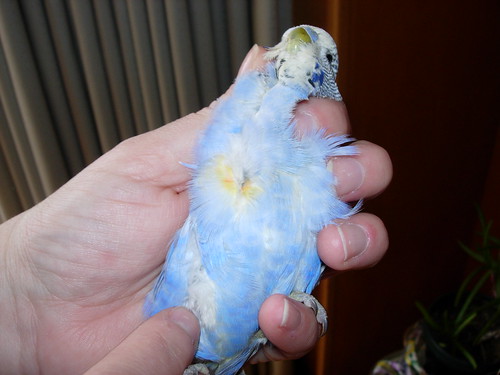
Birds don't have diaphragms; the only way they can breathe is by using the motion of their chests. That means if you just grip them like a soda can then they will quietly die on you while you're not looking. The way you actually hold birds is by putting your hand around the back of their heads and squeezing their mandibles. This image from google sort of gives you the idea.


Since they are tiny, they have really fast hearts. I believe the normal is around 350bpm and they can get up to 600bpm. When you put your stethoscope on them, they are so little that the bell pretty much covers up the entire thorax. The prof told us to listen to both sides of their lungs, but it was really more like sliding it 2mm towards the other side. It's so fast, it sounds like a machine--bdrrrrrrrrrrrrrrrrrrrrrrrrr.

If you lose your grip, which is easy to do because it is a weird grip, they will bite you. I did a lot of this while I was working at the aviary, and for something so tiny their bite hurts. Those beaks are perfectly suited for clamping down on things. 

One of the girls in my lab group was rather notorious for being timid around the animals and messing up. She also giggled a lot at inappropriate things. Therefore it wasn't too unexpected when I heard some shrieking, and turn to see that her bird had twisted its head and bitten her. Her response? She reflexively chucks the budgie. Then giggles. Fortunately, her friend was a bit more on top of things and clamped her free hand over the bird before it could go flying off, and the budgie was returned to the original girl without any fuss (apart from more shrieking and giggling, that is). One of my friends in the class below me has told me that a similar incident happened in their class the next year, only that time the bird actually did get away and started flapping around the room. She said they had to quickly shut all the doors, the prof grabbed the long net, and had to run around the room trying to catch it.

Saturday, 15 June 2013

Mentor-Mentee - My Turn!

Last year, as third years, it was our turn to be mentors to the incoming first years. I was pretty keen--my mentor was absolutely useless and never talked to me after the original mentor-mentee happy hour. I was going to hang out and be friends with a first year, and tell them all about vet school, and give them lots of notes and tips and resources.

I was Rudolph and my mentee was Santa.


Here's me. I did have a red nose, but I had long since given up trying to keep it on. My favourite part of this costume is not shown - I made a super cute fluffy deer tail out of ribbon and sewed it on the back. The necklace of bells and the antlers each took a really long time, even though I don't look like I spent any time on it.

I found my mentee and bought her a drink, as is the custom. I talked to her a bit, but she seemed like she would rather be left to talk to her friends so I did. I talked to heaps of the first years while I was there, which was really fun. It was their first week and they had no idea what they were getting into, and so many of them were shy.

I realised that we, as third years, knew everyone in our class. We could look at any person and know instantly if they were first or third year. The first years, on the other hand, hardly even knew each other. I think that's why they tended to cluster in little friend groups--they only knew a handful of familiar faces, and didn't know who else was in their class! After all, that's what it was like for us when we were first years.

Since then, my mentee contacted me a few times, and we are facebook friends. I gave her some files on a flash drive, in a very secretive exchange of moving the flash drive around between our mailboxes. We seem like pretty different people, though, so we never hung out.

Friday, 14 June 2013

What Cell Would You Be?

In clin path, when we were learning about eosinophils, our professor mentioned that the pathologists had once had a discussion about what cell you would be, or what cell describes your personality. (Because pathologists are the biggest nerds out of all of us)

She brought it up because she really loves horse eosinophils. They look sort of like raspberries.


There are a lot of cells I like, and some that I'm more partial to than others. My friend and I once talked about this in parasites--there were certain ones that spoke to us so we never got them wrong if they came up on a test. One of mine was Ancylostoma caninum, a hookworm in dogs.


Another was Toxocara canis because it is the same sort of worm as Dune sandworms.


But back to the topic, there are some nice cells to choose from. I quite like neutrophils because they stand out so clean and nicely on a blood smear.


They can be a little ragged, however. My favourite is one that is much more pristine--very smooth and fine: the spherocyte. Even the name has a nice roundness!

These are cells formed by partial phagocytosis--a macrophage takes a chomp out of a red blood cell, so the RBC stretches its membrane over the defect and gets smaller and more compact. They're present in immune-mediated haemolytic anaemia.


An Update From Study-Land

So as it turns out, vet school is hard. Vet school is really, really hard.

I pretty much spend the entire day in lectures, then come home and spend whatever time is left trying to catch up in textbook readings. It is finals week right now, and I literally spent more than 12 hours straight yesterday preparing for the small animal and surgery exam we had this morning. So you can see why I very quickly stopped updating the blog.

1. No time to write anything
2. No energy left
3. Not much to say! "Today, I studied."

Fortunately I did make notes on things even back in second year that I never got around to typing up. There are a few drafts I left behind, and I'll probably be sneaky and change the date on those when I finish them so I can pretend I posted them back then :P You won't get my naive outlook on it all, since it will be retrospective, but hopefully I can remember some good stories!

A big reason I wanted to keep blogging is that I want to keep some sort of diary of silly clients and bizarre cases. I thought, "Maybe I can blog them or something... oh wait, I already have a blog." So here's hoping for the future!

Thursday, 3 January 2013

What, you aren't a qualified surgeon?

In third year, we had a class called Clinical Studies, which was a hodgepodge of stuff that's important as a real-world vet, like how to do clinical exams, anaesthesia, and imaging. A large section of the course was dedicated to "introductory" surgery, like the basic principles of tissue handling. That was the aim, but the surgeons live in their own little surgery universe, and in order to pass the exam, you basically had to be a surgeon already.

Our class had to come together in a collaborative effort to answer the questions from past exams, even with all of our books and notes at hand. We made a massive google document full of every colour imaginable, with highlighted answers and multi-coloured discussions and arguments about which one was correct. Lots of spots have something in red or caps, asking "Can someone explain this??" Here's the top of the page when you open it:

I would just like to say good work everyone on all the question answering I think we can all say these questions are worded terribly and information is very inconsistent but GOOD LUCK FOR TOMORROW :) This will not be a very pleasant experience ...i resent this test and the people that prepared it

Here are a few examples of our attempts to answer the questions in the study guide (SG):

18. C because it SHOULDN’T be designed to enhance traffic flow through clean areas? (agreed) (p70 of SG confirms this)

19. A apparently can someone explain this? :)
Disinfectants are used to sanitize surfaces / Antiseptics are used to cleanse wounds / Autoclaves are used to sterilize instruments. Hope this helps
20. B

21. C (Isn’t this B...? The image is the same as the one in the lec slides) Yep pretty sure its B
22. C

23. C

24. G/D (lettering is not ideal on this question!) not sure bout this either, thoughts peeps. I agree theres a table on page 1062 of fossum that says it is.
                               
FROM FOSSUM - Allogeneic cancellous bone grafts provide limited mechanical support and are osteoconductive, but not osteoinductive because the matrix is mineralized.  Therefore, answer is NOT G/D. where is this? because according to the table cancellous allografts are osteoinductive..
Thus is the answer E????????    I thought none of the grafts were good at osteogenesis. If the graft was rendered inert it would have no more protein therefore cannot be osteogenic unless a protein source was added
yeah i think its E (the last option...E2).. the questions is asking for which one is true..

But it gets worse.

j)  An advancement flap in the shape of a U is created, in order to not compromise its vascularity, the ratio of the length to the width should not be greater than:
                                   
i)  1to1.        ??       
ii)  1.5 to 1.               
iii)  2to1.        ??       
iv)  3to1.               
v)  4to1                        

ok so been trying to find this one... and found a few recent articles/studies saying that ratio isn’t even a factor …. “Therefore, the traditional concept of a width-to-length ratio does not dictate flap survival, rather perfusion pressure does.”    
anyways it carries on to say “ Classically, advancement flaps have a length-to-width ratio of 1:1 or 2:1” WHICH STILL DOESN’T HELP US!

The questions are ridiculously pedantic. Look at these. Seriously, the fuck?? WHY WOULD ANYONE KNOW THIS? Let alone in introductory surgery in third year, when you've barely even begun learning anything past anatomy, genetics, and microbiology.

When using Chlorhexidine solution (stock strength = 4%) to lavage a wound what is the maximum concentration that should be used?
                           
(a)  1 part in 10 of saline.                            
(b)  1 part in 20 of saline. p.27 has lavage concentration should be .05 = 1/20)??   
(c)  1 part in 30 of saline                            
(d)  1 part in 40 of saline.     Fossum says 1:40                       
(e)  1 part in 50 of saline. ← I thought it was 1ml to 80ml but....
       
you want to get Chlorhexidine down to 0.05% soln thus need to dilute it down 20 times
e.g. 10ml chlorhexidine diluted by 200ml saline = 0.05%
10/200 = 0.05%  actually idk    (I agree with B since that’s what the SG says.. eg 1/20=0.05)

You have to remember you are starting with a 4% solution......  So, you can’t just do 1/20.....  Besides 1/20 gives 5% not 0.05%

there was a something on the internet that had it as 1 part in 40 but I can’t find the link anymore..some textbook on google books...
ughhh me gad!

2. The maximum level of bacterial contamination required for successful wound closure in surgical wounds is generally considered to be:
a. 104 / g of tissue
b. 105 / g of tissue
c. 107 / g of tissue
d. 109 / g of tissue

Plus there's the questions like this one, about fistulas. We never talked about fistulas. Not once. I had no idea what a fistula was before I saw this question, let alone had any clue how to answer something about surgical management of one. Plus you'll notice this question goes from cow teats to foaling injuries. You may be beginning to see why vet school is so stressful.


18. Which of the following is a correct statement about a fistula?
(a) When closing a teat fistula in a cow the most important layer to make leak
proof is the mucosa.
(b) When closing a teat fistula in a cow the most important layer to make leak
proof is the skin.
(c) When closing a teat fistula in a cow preserving the epithelial tract will
accelerate healing. ← maybe this one but i really have no idea
(d) When repairing a foaling injury that has resulted in a rectovaginal fistula in
a mare a complete closure of the vaginal mucosa is more important than
the rectal mucosa. i know rectovaginal tears are not usually closed right away to allow for swelling to go down, but I think the vaginal mucosa is the most important thing to worry about (to reduce further infection from the rectum)...
(e) In time most fistulas will close as wound contraction is completed. 

Our whole document was 28 pages long. It was full of misery and stress and colour. Here's the best part, however:

Five minutes before the exam was about to start, as we were sitting at our computers ready to open the program, one of the high-up vet school coordinators appears. He only tends to appear to yell at us, so I immediately knew something was wrong.

It turns out that the surgeon had put the test online ahead of time over the weekend, because he was going to a concert or something. A few people in the class noticed it and accessed it. For some reason, the school decided to wait until that moment in time to let us know about the security breach and change the test. They had to throw out the multiple-choice test and throw something together for us. We would meet in a lecture room in half an hour, and would be taking a written test instead.

People cried.