Today I turned someone's dog orange.
Fortunately, it was a classmate, not a client, and it was during an ophthalmology practical lab. Which, by the way, no one told us we had until the ophthalmologist actually walked through the door into the hospital and we're like, "Uhhh, I guess we do have a prac this afternoon." It was finally confirmed that it was supposed to take place at 1pm (confirmed at 1pm), and as we all rush to arrive--including a number of students off on lunch--we suddenly realised we also had no idea where the prac was. Also it was very inconveniently timed and I had to miss my only consult for the day, rendering my day rather useless.
Anyway, back to the point--orangeness. Amongst other things, we were given a bunch of fluorescein dye to put in the dogs' eyes. It sticks to ulcers, glows under UV light, and just drains out through the tear ducts and into the nose. Usually you squirt it into the eye with a syringe or dropper or something, but for some reason we had a bazillion little strips with dye-coated tips. I used one of those. Why not?
There were only three dogs. One had some eye pathology so was constantly surrounded by a cloud of students and had lights shined into both eyes for pretty much the entire duration of the lab. One was teeny tiny and at that moment also being examined by others. So I selected the remaining dog, my classmate's, considering people were just sitting by her, talking. I should mention that this dog has white fur.
I went ahead and stuck the strip in like normal, but the dog squinted her eye shut around it really tightly, to the point that the eyelid rolled inward. After about 10 seconds, it became clear that orange was seeping out around her eye. I removed the strip and she opened the eye. She suddenly had a giant spot all around her eye, bright orange. It seemed to be an inordinately large spot considering the procedure, and it was contrasted nicely by the sheer whiteness of the fur around it.
To be fair, I did get the fluorescein into her eye. I don't think she has an ulcer.
(To add insult to injury, no one was paying much attention to the fluorescein strips, and I'm pretty sure some of my classmates thought something had gone horribly wrong with the syringe/dropper method.)
Showing posts with label Working With Alive Things. Show all posts
Showing posts with label Working With Alive Things. Show all posts
Monday, 27 January 2014

Wednesday, 31 July 2013
Stories From First Year: Aviary
This one didn't actually happen in first year, I think it was all the way after second year, but I didn't want to mess up my nice title series! Theoretically I could have done it in first year...
For my three weeks of "other" practical work, I picked birds! I worked at the aviary in the Esplanade that summer, which has dozens of species kept in all kinds of enclosures. Two of the enclosures house native New Zealand ducks that they're breeding as part of a conservation program. There's everything from the little songbirds and parrots, to pheasants and peacocks.
My favourite was a sulfur-crested cockatoo that suffered an old gunshot injury, so now climbs and walks around rather than flying. He knows how to speak and would say "hello" to me, and followed me around the enclosure by climbing along the walls. My least favourite was his neighbours, two more sulfur-crested cockatoos that got upset at my presence and liked to attack. More than once, I heard some flapping only to turn around and find a giant white bird hurtling towards my face.
The bird-keeper was a pleasant old fellow, but boy did he move slowly. He'd pause regularly to chat, whether it was out in the enclosures, or just hanging out at his computer as he showed me about a thousand photos from his trip to Africa. He usually took a full half hour at both morning and afternoon tea breaks, as well as a lengthy lunch. During that time I learned all the rules to darts and also drank more tea than I had in my entire life. Even if I didn't make myself tea, someone else usually brought me one. We spent so much time fluffing around to fill up the day, that one day when he was absent and I had to do all the enclosures myself, I got everything cleaned and fed by lunchtime. I scratched my head for a bit wondering how two people could take twice as long, then went home.
I was surprised by the birds' diets, having not had much experience. Making up their food is kind of fun, because they eat so much human food. Apart from their seeds (different combos for each enclosure), they also got fresh and frozen vegetables including corn, carrots, and peas. They got lettuce and silverbeet, apples, and some of them also got cheese, dried fruits, or honey water. To be honest, it sounded like a pretty delicious picnic some days.
At one point, we de-wormed all the budgies, which involved sticking tubes down their throats on two separate occasions--and there were 70 budgies. This was great handling experience, but I might mention that budgies bite hard.
My absolute favourite part was the Monster. I believe it was actually a Kea or some such bird, but I had to take bird-guy's word for it, because I never saw it. It had a huge enclosure with big bushes and a big house with concrete cylinders and other structures. I'd come in every day and drop off new lettuce, and find the previous day's three-quarters-eaten veggies strewn about. The apples would disappear. The water would decrease. But no bird. Ever. I decided it was actually a creature out of some horror movie, shrouded in mystery--the Kea thing is just a ruse.
For my three weeks of "other" practical work, I picked birds! I worked at the aviary in the Esplanade that summer, which has dozens of species kept in all kinds of enclosures. Two of the enclosures house native New Zealand ducks that they're breeding as part of a conservation program. There's everything from the little songbirds and parrots, to pheasants and peacocks.
My favourite was a sulfur-crested cockatoo that suffered an old gunshot injury, so now climbs and walks around rather than flying. He knows how to speak and would say "hello" to me, and followed me around the enclosure by climbing along the walls. My least favourite was his neighbours, two more sulfur-crested cockatoos that got upset at my presence and liked to attack. More than once, I heard some flapping only to turn around and find a giant white bird hurtling towards my face.
The bird-keeper was a pleasant old fellow, but boy did he move slowly. He'd pause regularly to chat, whether it was out in the enclosures, or just hanging out at his computer as he showed me about a thousand photos from his trip to Africa. He usually took a full half hour at both morning and afternoon tea breaks, as well as a lengthy lunch. During that time I learned all the rules to darts and also drank more tea than I had in my entire life. Even if I didn't make myself tea, someone else usually brought me one. We spent so much time fluffing around to fill up the day, that one day when he was absent and I had to do all the enclosures myself, I got everything cleaned and fed by lunchtime. I scratched my head for a bit wondering how two people could take twice as long, then went home.
I was surprised by the birds' diets, having not had much experience. Making up their food is kind of fun, because they eat so much human food. Apart from their seeds (different combos for each enclosure), they also got fresh and frozen vegetables including corn, carrots, and peas. They got lettuce and silverbeet, apples, and some of them also got cheese, dried fruits, or honey water. To be honest, it sounded like a pretty delicious picnic some days.
At one point, we de-wormed all the budgies, which involved sticking tubes down their throats on two separate occasions--and there were 70 budgies. This was great handling experience, but I might mention that budgies bite hard.
My absolute favourite part was the Monster. I believe it was actually a Kea or some such bird, but I had to take bird-guy's word for it, because I never saw it. It had a huge enclosure with big bushes and a big house with concrete cylinders and other structures. I'd come in every day and drop off new lettuce, and find the previous day's three-quarters-eaten veggies strewn about. The apples would disappear. The water would decrease. But no bird. Ever. I decided it was actually a creature out of some horror movie, shrouded in mystery--the Kea thing is just a ruse.
Tuesday, 30 July 2013
Stories From First Year: Sheep and Beef
This one was in New Zealand, and again all I did was odds and sods. I put up some electric fences sometimes, but mostly I rode shotgun in the tractor, jumping out to open gates. Fortunately the old farmer I was with was very fun to talked to and loves making friends with international students (he introduced me to some other international students).
He also let me drive the tractor once. I am totally into that. I even parked it perfectly. Little me, up in this massive tractor, roaring down the farm track at like... 10kph. Well maybe it was faster than that. I don't remember. It was an automatic transmission so I didn't have to do much work at all, but it's something to cross off the bucket list.
The other thing I really liked was watching the farm dogs work, because they are so beautiful and well trained.
The most annoying day for me was sorting wool. Good god. It wasn't even shearing time, it was just crutching--taking the wool off around their bums so they don't get covered in poo--so it was way less wool than I would have had to face at shearing time. Still, that was one unpleasant day. From eight in the morning until I left at five in the evening, we were in the wool shed, with an endless stream of sheep, just me and the socially awkward shearer. I had a sort of stick thing that I used to sweep the wool off the platform, which sometimes involved sneaky maneuvers around his feet or behind him. Then, since it had just rained of course, I had to lay out anything super wet to dry, because apparently if you pile up wet wool it explodes.
My skin is sensitive to wool, so by the end of the day, not only did I have a cramp from wielding my wool-stick, and not only were my hands covered in wool grease, they were also all red and itchy. It was also a bit of an adventure trying to get all the wool into the wool compressor thing. At first it went well, but around lunchtime the bin was pretty full, and there wasn't anywhere else for me to put the wool. So after that point I had to periodically climb up into the bin and jump up and down and stomp around on top of the wool until I made enough room to fit more in. Then of course when I did that, I got behind, because the shearer just kept on going, so the wool on the platform would amass and I'd have to frantically try to sort it out before it built up into some sort of wool ocean.
The worst part was that we didn't quite finish, and I had to come back and do more the next day. Ugh my hands were prickly needly greasy itchy sore globs of death.
He also let me drive the tractor once. I am totally into that. I even parked it perfectly. Little me, up in this massive tractor, roaring down the farm track at like... 10kph. Well maybe it was faster than that. I don't remember. It was an automatic transmission so I didn't have to do much work at all, but it's something to cross off the bucket list.
The other thing I really liked was watching the farm dogs work, because they are so beautiful and well trained.
The most annoying day for me was sorting wool. Good god. It wasn't even shearing time, it was just crutching--taking the wool off around their bums so they don't get covered in poo--so it was way less wool than I would have had to face at shearing time. Still, that was one unpleasant day. From eight in the morning until I left at five in the evening, we were in the wool shed, with an endless stream of sheep, just me and the socially awkward shearer. I had a sort of stick thing that I used to sweep the wool off the platform, which sometimes involved sneaky maneuvers around his feet or behind him. Then, since it had just rained of course, I had to lay out anything super wet to dry, because apparently if you pile up wet wool it explodes.
My skin is sensitive to wool, so by the end of the day, not only did I have a cramp from wielding my wool-stick, and not only were my hands covered in wool grease, they were also all red and itchy. It was also a bit of an adventure trying to get all the wool into the wool compressor thing. At first it went well, but around lunchtime the bin was pretty full, and there wasn't anywhere else for me to put the wool. So after that point I had to periodically climb up into the bin and jump up and down and stomp around on top of the wool until I made enough room to fit more in. Then of course when I did that, I got behind, because the shearer just kept on going, so the wool on the platform would amass and I'd have to frantically try to sort it out before it built up into some sort of wool ocean.
The worst part was that we didn't quite finish, and I had to come back and do more the next day. Ugh my hands were prickly needly greasy itchy sore globs of death.
Saturday, 27 July 2013
Stories From First Year: Equine
A horse stables was the second of my practical experiences, and similarly involved a lot of new understanding about how horses are kept and what to do around them. It's pretty dull to talk about--I shoveled out stalls, fed the horses, groomed some horses, routine stuff like that. I did get a fair amount of responsibility with the horses, which was very lucky because apparently plenty of my classmates got stuck with some really boring equine time. Some places don't want you touching horses at all if you have no experience, so my friends got to do nothing but shovel stalls for three weeks straight.
One thing that amuses me is that horses require snow shoes so they don't skate around all over the ice, or get it packed up into their hooves. It was slightly terrifying to be leading this massive beast and have it slip on the ice and get a fright. I think I panicked more than the horses. They also got snow jackets, which I had to put on in the morning before they went out, then take off in the evening. The horses were surprisingly docile and pleasant to work with, which isn't my experience with horses in general.
I got to be mini-vet when one of the horses got kicked by another horse, and it became my duty to clean the wound and dress it every day.
The best part was all the other animals. In other stalls they had two ponies, two alpacas, a llama, and a donkey. Roaming free they had a goat, a tiny ugly pig, and a super fat sheep, and also a very handsome dog and a bazillion cats. And a domesticated raccoon that is the fattest raccoon I've ever seen.
The alpacas were skittish, but made adorable little mewling noises. The goat had some serious personality, and constantly sat on things that I needed and chewed on stuff and got into things. The ponies were fun to be around, but I'm not sure why. The llama was the best--I got to lead it out to pasture just like the horses, and it's just... llamas are really hilarious. They look funny and move funny and act funny. I think it got free at one point and the people who worked there had to go chase it back. The raccoon was cute, but had crazy sharp teeth and claws. It constantly chowed down on the cat food, which is how it got so fat, and it would come up and beg around people (which was not fun considering how sharp its claws are when it's grabbing at your leg or your sleeve).
One thing that amuses me is that horses require snow shoes so they don't skate around all over the ice, or get it packed up into their hooves. It was slightly terrifying to be leading this massive beast and have it slip on the ice and get a fright. I think I panicked more than the horses. They also got snow jackets, which I had to put on in the morning before they went out, then take off in the evening. The horses were surprisingly docile and pleasant to work with, which isn't my experience with horses in general.
I got to be mini-vet when one of the horses got kicked by another horse, and it became my duty to clean the wound and dress it every day.
The best part was all the other animals. In other stalls they had two ponies, two alpacas, a llama, and a donkey. Roaming free they had a goat, a tiny ugly pig, and a super fat sheep, and also a very handsome dog and a bazillion cats. And a domesticated raccoon that is the fattest raccoon I've ever seen.
The alpacas were skittish, but made adorable little mewling noises. The goat had some serious personality, and constantly sat on things that I needed and chewed on stuff and got into things. The ponies were fun to be around, but I'm not sure why. The llama was the best--I got to lead it out to pasture just like the horses, and it's just... llamas are really hilarious. They look funny and move funny and act funny. I think it got free at one point and the people who worked there had to go chase it back. The raccoon was cute, but had crazy sharp teeth and claws. It constantly chowed down on the cat food, which is how it got so fat, and it would come up and beg around people (which was not fun considering how sharp its claws are when it's grabbing at your leg or your sleeve).
Thursday, 25 July 2013
Stories From First Year: Dairy
Ever since I started this blog, I've had "prac work" on my list of topics to write about. It would have been fun to see my original impressions of everything, but maybe the reason I never got around to it is that I couldn't think of any particularly exciting stories to tell. Now that I've finished all of them, I think I can cobble together an interesting assortment of notes from my experiences. We had to do 16 weeks on various farms during our breaks and summers, and I'll talk about them one at a time.
The first one I did was on a dairy farm in the states. As someone with no large animal experience, I didn't have a clue about working around cows or what a dairy farm was like at all. I remember being quite surprised at how all the cows had electronic collars, and the milking machine registered it and recorded their individual milk production and sent it to the computer, where you could look at it in charts and graphs. I also was impressed by the gigantic automatic pooper-scooper that moves slowly back and forth across the floor.
The most fun was on days when the vet came. I followed him around and talked to him heaps, and he let me help on a few surgeries. It was my first year out of vet school, so it was the first time I was ever treated as a vet student. I remember feeling excited but also super confused at all the vet-lingo he fired at me, as he explained the surgery. At this point I didn't even know cow anatomy, so my thoughts were along the lines of "I don't know what he's talking about but it sounds so professional and cool!"
The other distinct memory I have is following him while he was doing pregnancy scanning, and this one cow followed us the whole time. She kept rubbing up against me and pushing her head into me and sort of knocking me around. Cows are really cute!
Unfortunately, the farm I was on was well run and had everything covered. They didn't need a student to do anything, so apart from the odd job here and there, there really wasn't anything for me to do. The one time I tried to help out in the calf barn, I got myself completely soaked from trying to carry the big water buckets. Most of the work was done by a handful of Guatemalans. I ended up spending most of my time helping out with milking, and the Guatemalans flirted with me and tried to teach me Spanish.
As it turns out, that farm was a barn-based system, and in New Zealand it's largely pastoral farming, so when I got back to school I still was clueless about what we were learning. I spent the next two years trying to sort it all out in my head. Pasture-based farming is really different, but more fascinating I think.
The first one I did was on a dairy farm in the states. As someone with no large animal experience, I didn't have a clue about working around cows or what a dairy farm was like at all. I remember being quite surprised at how all the cows had electronic collars, and the milking machine registered it and recorded their individual milk production and sent it to the computer, where you could look at it in charts and graphs. I also was impressed by the gigantic automatic pooper-scooper that moves slowly back and forth across the floor.
The most fun was on days when the vet came. I followed him around and talked to him heaps, and he let me help on a few surgeries. It was my first year out of vet school, so it was the first time I was ever treated as a vet student. I remember feeling excited but also super confused at all the vet-lingo he fired at me, as he explained the surgery. At this point I didn't even know cow anatomy, so my thoughts were along the lines of "I don't know what he's talking about but it sounds so professional and cool!"
The other distinct memory I have is following him while he was doing pregnancy scanning, and this one cow followed us the whole time. She kept rubbing up against me and pushing her head into me and sort of knocking me around. Cows are really cute!
Unfortunately, the farm I was on was well run and had everything covered. They didn't need a student to do anything, so apart from the odd job here and there, there really wasn't anything for me to do. The one time I tried to help out in the calf barn, I got myself completely soaked from trying to carry the big water buckets. Most of the work was done by a handful of Guatemalans. I ended up spending most of my time helping out with milking, and the Guatemalans flirted with me and tried to teach me Spanish.
As it turns out, that farm was a barn-based system, and in New Zealand it's largely pastoral farming, so when I got back to school I still was clueless about what we were learning. I spent the next two years trying to sort it all out in my head. Pasture-based farming is really different, but more fascinating I think.
Thursday, 20 June 2013
Cow Mittens
In every vet student's life, there comes the day when you finally put your hand up a cow's arse.
This is, in fact, one of the more exciting events in third year--partly because it's a big milestone, and partly because the lab that week is only one hour instead of two or three. By the end, they pretty much have to kick us out, but it can only be an hour because it starts irritating the cows, so they get all oedematous and you can't feel anything anymore. It also kills your arm.
The first step is to get a plastic apron. For us, these are on hooks that are quite a bit above my head, and they are also aprons made for giants, so I have an awkward time getting one down. Then you tie it around yourself to create a plastic wall that goes straight to the floor for an average height woman, and shuffle across the room with it. The next step is to don the plastic gloves, or rather, the plastic sleeves. They're usually yellow or orange and there are a few difficulties in getting them on. The plastic sticks together, so everyone is blowing down their sleeves like balloons to try and get them to puff out, and trying to peel apart the fingers and wedge their hands in. You pull the sleeve up over your shoulder and hope that it stays there, but they are such a weird size and shape this doesn't work for everyone.
Then, as some students bring in the cows and direct them into holding area, the rest of us line up. There are big containers of lube that you upturn onto your hands, and I always manage to spill a bunch on the floor doing so, and you rub it all over the plastic sleeves. The last thing to do is pick a cow, and maybe listen to whatever the professor says.
The very first time, he gave us a quick rundown of all the things we could palpate per rectum before we moved on to the reproductive tract (which is the main point of doing this in a cow). He started off pointing out the aorta up top and how you can feel it beat, as well as the bifurcation as it splits off towards the legs, and I got so distracted looking for it and then being excited about it that I totally missed the rest of the "quick rundown." I remember the left kidney and the rumen but I'm not sure what else he said.
The rest of the time of that lab, and every other attempt after it, was spent trying to find the stupid uterus. Supposedly the cervix is the easy part to feel, and you use that to pull up the uterine horns and ovaries. My classmates were always like, "I can feel a corpus luteum!" or "I think there's a follicle on the left ovary," and I have no idea how they managed that so quickly. Sometimes I could quickly find the cervix, but when I tried to pull up the uterus I could never find the bifurcation. Other times, I felt a hard ball that certainly must have been an ovary, but there was no cervix to be found (and as soon as I let go, I couldn't find it again, of course). It got even more difficult later in the year when the cows were pregnant--I really have no idea how to tell what is going on inside those cows. Pregnant? Not sure. How far along? Definitely no clue.
The ridiculous part of doing this is the peristalsis on the part of the cow. In the middle of you rummaging around in there trying to find stuff, occasionally there is a sudden increase in pressure that squeezes all the way down your arm. The first few times, I wasn't expecting it, and it pushed me right out of the damn cow. Then I learned you just have to let go, relax your arm, and wait for it to pass. There is literally nothing I can do until the wave is done--you would not believe how strong it is! This is part of the reason your arm gets tired.
Finally, the lab we had at the beginning of this year, I could consistently find the uterus and ovaries. Finally. Still not so sure about pregnant cows.
This is, in fact, one of the more exciting events in third year--partly because it's a big milestone, and partly because the lab that week is only one hour instead of two or three. By the end, they pretty much have to kick us out, but it can only be an hour because it starts irritating the cows, so they get all oedematous and you can't feel anything anymore. It also kills your arm.
The first step is to get a plastic apron. For us, these are on hooks that are quite a bit above my head, and they are also aprons made for giants, so I have an awkward time getting one down. Then you tie it around yourself to create a plastic wall that goes straight to the floor for an average height woman, and shuffle across the room with it. The next step is to don the plastic gloves, or rather, the plastic sleeves. They're usually yellow or orange and there are a few difficulties in getting them on. The plastic sticks together, so everyone is blowing down their sleeves like balloons to try and get them to puff out, and trying to peel apart the fingers and wedge their hands in. You pull the sleeve up over your shoulder and hope that it stays there, but they are such a weird size and shape this doesn't work for everyone.
Then, as some students bring in the cows and direct them into holding area, the rest of us line up. There are big containers of lube that you upturn onto your hands, and I always manage to spill a bunch on the floor doing so, and you rub it all over the plastic sleeves. The last thing to do is pick a cow, and maybe listen to whatever the professor says.
The very first time, he gave us a quick rundown of all the things we could palpate per rectum before we moved on to the reproductive tract (which is the main point of doing this in a cow). He started off pointing out the aorta up top and how you can feel it beat, as well as the bifurcation as it splits off towards the legs, and I got so distracted looking for it and then being excited about it that I totally missed the rest of the "quick rundown." I remember the left kidney and the rumen but I'm not sure what else he said.
The rest of the time of that lab, and every other attempt after it, was spent trying to find the stupid uterus. Supposedly the cervix is the easy part to feel, and you use that to pull up the uterine horns and ovaries. My classmates were always like, "I can feel a corpus luteum!" or "I think there's a follicle on the left ovary," and I have no idea how they managed that so quickly. Sometimes I could quickly find the cervix, but when I tried to pull up the uterus I could never find the bifurcation. Other times, I felt a hard ball that certainly must have been an ovary, but there was no cervix to be found (and as soon as I let go, I couldn't find it again, of course). It got even more difficult later in the year when the cows were pregnant--I really have no idea how to tell what is going on inside those cows. Pregnant? Not sure. How far along? Definitely no clue.
The ridiculous part of doing this is the peristalsis on the part of the cow. In the middle of you rummaging around in there trying to find stuff, occasionally there is a sudden increase in pressure that squeezes all the way down your arm. The first few times, I wasn't expecting it, and it pushed me right out of the damn cow. Then I learned you just have to let go, relax your arm, and wait for it to pass. There is literally nothing I can do until the wave is done--you would not believe how strong it is! This is part of the reason your arm gets tired.
Finally, the lab we had at the beginning of this year, I could consistently find the uterus and ovaries. Finally. Still not so sure about pregnant cows.
Sunday, 16 June 2013
Budgerigar-ing
In third year clinical studies, one of our labs was about bird handling and the avian clinical exam. They brought in four or five travel cages full of budgies from the local aviary.
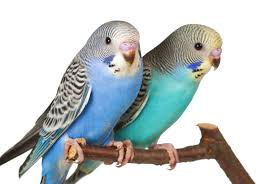
After a briefing, we were sent off to grab a budgie each and start practicing. Since they are tiny, we wanted to be careful, but they also turn into little flapping panicking escape-machines when you try to get them out of the cage. We had to reach in through the hand-sized flap on the side of the box, isolate a bird, and sort of (gently) squash it against a wall or floor so you could get a grip on it. Then, hopefully, the bird didn't wriggle out while you tried to one-handedly extract it from the cage.
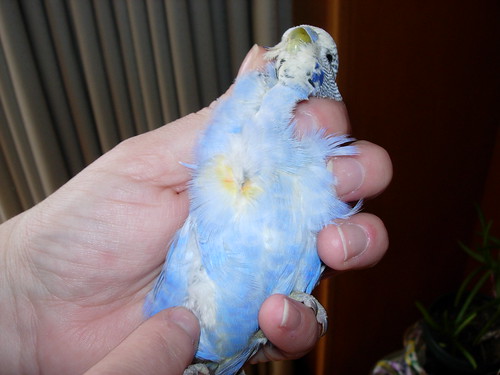
Birds don't have diaphragms; the only way they can breathe is by using the motion of their chests. That means if you just grip them like a soda can then they will quietly die on you while you're not looking. The way you actually hold birds is by putting your hand around the back of their heads and squeezing their mandibles. This image from google sort of gives you the idea.
After a briefing, we were sent off to grab a budgie each and start practicing. Since they are tiny, we wanted to be careful, but they also turn into little flapping panicking escape-machines when you try to get them out of the cage. We had to reach in through the hand-sized flap on the side of the box, isolate a bird, and sort of (gently) squash it against a wall or floor so you could get a grip on it. Then, hopefully, the bird didn't wriggle out while you tried to one-handedly extract it from the cage.
Birds don't have diaphragms; the only way they can breathe is by using the motion of their chests. That means if you just grip them like a soda can then they will quietly die on you while you're not looking. The way you actually hold birds is by putting your hand around the back of their heads and squeezing their mandibles. This image from google sort of gives you the idea.
Since they are tiny, they have really fast hearts. I believe the normal is around 350bpm and they can get up to 600bpm. When you put your stethoscope on them, they are so little that the bell pretty much covers up the entire thorax. The prof told us to listen to both sides of their lungs, but it was really more like sliding it 2mm towards the other side. It's so fast, it sounds like a machine--bdrrrrrrrrrrrrrrrrrrrrrrrrr.
If you lose your grip, which is easy to do because it is a weird grip, they will bite you. I did a lot of this while I was working at the aviary, and for something so tiny their bite hurts. Those beaks are perfectly suited for clamping down on things.
One of the girls in my lab group was rather notorious for being timid around the animals and messing up. She also giggled a lot at inappropriate things. Therefore it wasn't too unexpected when I heard some shrieking, and turn to see that her bird had twisted its head and bitten her. Her response? She reflexively chucks the budgie. Then giggles. Fortunately, her friend was a bit more on top of things and clamped her free hand over the bird before it could go flying off, and the budgie was returned to the original girl without any fuss (apart from more shrieking and giggling, that is). One of my friends in the class below me has told me that a similar incident happened in their class the next year, only that time the bird actually did get away and started flapping around the room. She said they had to quickly shut all the doors, the prof grabbed the long net, and had to run around the room trying to catch it.
Sunday, 30 September 2012
There's Something Fishy About This Lab
A week or two ago, we had a fish handling lab.
Did you know that people anaesthetise fish? Fish are sedated before they are killed commercially, but people also have valuable pet fish or display fish (like in an aquarium) that sometimes get sick and need veterinary care. There are a number of basic diagnostic techniques for investigating what could be wrong with a sick fish, and medicine or even surgery can be used to treat them.
Fish anaesthesia is surprisingly like mammalian anaesthesia. For a dog, the anaesthetic is vaporised and they breathe it in through their lungs via the anaesthetic machine. For a fish, it's basically the same: the drug is dissolved in the water rather than the air, and they "breathe" it in through their gills. If a dog is too deep, you give it pure oxygen to breathe for a while; for a fish, you put them into fresh water to breathe for a while.
Unfortunately for me, I managed to pick crappy fish for my partner and myself. They would not go to sleep. As they get more sedated, they lose their balance reflexes (float sideways and stuff), but it can freak them out a little as they go down. So one would have a panic attack, and that would wake up the other one, which was just drifting off. Then the first one would calm down, but the second one got a fright. The professor came by to increase the dose three times after the first lot! We spent at least half of our lab time staring into the bucket waiting for them to be deep enough to work with. It didn't help that we kept thinking they were fine, picking them up, and then they would flop around and wake up and we'd have to put them back. As an aside, the anaesthetic we were using is derived from clove oil, so the lab smelled like a strange combination of live fish and cloves.
Once they were asleep, we could take them out and do things to them. They survive in the air because their metabolism and respiration is slowed down so much under anaesthesia. Normally you have to keep them really wet to protect their skin, however. Our lab was designed to be a non-recovery lab, using fish at the end of their lives and such, so we didn't worry about that.
First thing we did was take blood. There's a vein in their tail, right in front of the fin, and we spent almost the entire rest of our lab time trying to stab it. If the needle goes through a scale on the way in, you plug up the thing with keratin and have to get a new needle. Little fish have little veins and not a lot of blood, so it was a pretty frustrating endeavour. The other site I tried was the dorsal aorta, which sounds really scary: you stick the needle into the back of their mouths, and that's apparently right where the aorta comes off the heart. I blindly stuck mine in and actually got an entire drop of blood right off the bat, but everyone else I talked to had a much harder time with that one.
Another thing we did was skin scrapes, which is apparently quite useful as fish can get protozoal infections, and if you put the mucus on a slide, you can see the protozoa move around. Our fish were not so interesting.
The last thing we did with the live fish was a gill biopsy. If you don't know anything about fish physiology, I have to tell you, gills are cool. They look cool, they are designed cool, they are just cool. You can also snip off a tiny piece with scissors, put it on a slide, and have a look for disease or degeneration that might be making the fish sick (it would be like people having a lung problem). Electron micrograph photo:

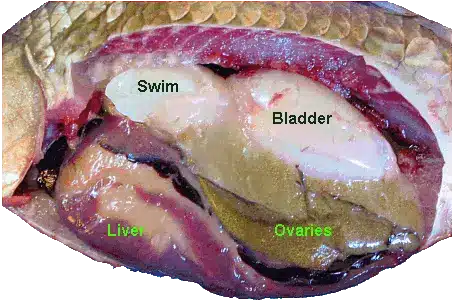
The last thing we did was euthanise the fish and do a post mortem. My partner and I had basically no time to do this, so we only had a quick look before lab ended. They have inflated swim bladders next to the kidney, that was the neatest thing, like a little balloon inside their body cavity. They have teeny tiny little spleens, massive massive ovaries filled with eggs, a simple two chambered heart, and skinny twisty intestines. From google:
Did you know that people anaesthetise fish? Fish are sedated before they are killed commercially, but people also have valuable pet fish or display fish (like in an aquarium) that sometimes get sick and need veterinary care. There are a number of basic diagnostic techniques for investigating what could be wrong with a sick fish, and medicine or even surgery can be used to treat them.
Fish anaesthesia is surprisingly like mammalian anaesthesia. For a dog, the anaesthetic is vaporised and they breathe it in through their lungs via the anaesthetic machine. For a fish, it's basically the same: the drug is dissolved in the water rather than the air, and they "breathe" it in through their gills. If a dog is too deep, you give it pure oxygen to breathe for a while; for a fish, you put them into fresh water to breathe for a while.
Unfortunately for me, I managed to pick crappy fish for my partner and myself. They would not go to sleep. As they get more sedated, they lose their balance reflexes (float sideways and stuff), but it can freak them out a little as they go down. So one would have a panic attack, and that would wake up the other one, which was just drifting off. Then the first one would calm down, but the second one got a fright. The professor came by to increase the dose three times after the first lot! We spent at least half of our lab time staring into the bucket waiting for them to be deep enough to work with. It didn't help that we kept thinking they were fine, picking them up, and then they would flop around and wake up and we'd have to put them back. As an aside, the anaesthetic we were using is derived from clove oil, so the lab smelled like a strange combination of live fish and cloves.
Once they were asleep, we could take them out and do things to them. They survive in the air because their metabolism and respiration is slowed down so much under anaesthesia. Normally you have to keep them really wet to protect their skin, however. Our lab was designed to be a non-recovery lab, using fish at the end of their lives and such, so we didn't worry about that.
First thing we did was take blood. There's a vein in their tail, right in front of the fin, and we spent almost the entire rest of our lab time trying to stab it. If the needle goes through a scale on the way in, you plug up the thing with keratin and have to get a new needle. Little fish have little veins and not a lot of blood, so it was a pretty frustrating endeavour. The other site I tried was the dorsal aorta, which sounds really scary: you stick the needle into the back of their mouths, and that's apparently right where the aorta comes off the heart. I blindly stuck mine in and actually got an entire drop of blood right off the bat, but everyone else I talked to had a much harder time with that one.
Another thing we did was skin scrapes, which is apparently quite useful as fish can get protozoal infections, and if you put the mucus on a slide, you can see the protozoa move around. Our fish were not so interesting.
The last thing we did with the live fish was a gill biopsy. If you don't know anything about fish physiology, I have to tell you, gills are cool. They look cool, they are designed cool, they are just cool. You can also snip off a tiny piece with scissors, put it on a slide, and have a look for disease or degeneration that might be making the fish sick (it would be like people having a lung problem). Electron micrograph photo:
The last thing we did was euthanise the fish and do a post mortem. My partner and I had basically no time to do this, so we only had a quick look before lab ended. They have inflated swim bladders next to the kidney, that was the neatest thing, like a little balloon inside their body cavity. They have teeny tiny little spleens, massive massive ovaries filled with eggs, a simple two chambered heart, and skinny twisty intestines. From google:
Sunday, 29 May 2011
Describing a Place
Topography sort of means "describing a place," from its Latin roots, and in medicine it means looking at and feeling the surface of the patient and knowing what's up underneath. It's the reason I haven't posted hardly any stories lately (I had Mr Vet saved up to post when things got dire), because it took the form of an oral exam this past week.

The first thing I did was pet the dog. The first thing I was actually supposed to do was pick out four cards from different piles, and each one had two questions on it. The way it worked was he would name a structure, and I would palpate it and describe anything I could think of--nearby structures and landmarks, function, clinical significance. The entirety of anatomy examinable, both this year and last, and more than two weeks of study. It took about 10 minutes.
The exam consisted of an examiner, a scribe, a dog, and me. The dog's name was Merlin and he looked kind of like this (picture from google):
The first thing I did was pet the dog. The first thing I was actually supposed to do was pick out four cards from different piles, and each one had two questions on it. The way it worked was he would name a structure, and I would palpate it and describe anything I could think of--nearby structures and landmarks, function, clinical significance. The entirety of anatomy examinable, both this year and last, and more than two weeks of study. It took about 10 minutes.
Unfortunately I wasn't just nervous, I was embarrassed about being so nervous. I petted the dog a lot, it didn't help.
The upshot is that now you can pretty much point anywhere on a dog, and I can tell you all kinds of shit about whatever it is you pointed at.
PS: It is way easier to find the femoral pulse on an alive dog than on a dead one. I was unduly surprised when I felt it.
Friday, 15 April 2011
Animal Handling: The Smallies
As part of Animal Behaviour, Handling, and Welfare last year, you might guess that we needed to handle some animals. I described our adventures with the large animals in the last post, leaving dogs and cats.
Of the two, I had cats first. This was at a cat research centre that is depicted as a blank square on the campus map. Apparently, if they actually label it, animal rights people that don't know what they're doing will show up and try to set all the cats free.
The place is a bit of a mystery to enter. It was way out of the way, interspersed with other mysterious buildings, and the entrance was locked. Peering in through the door, I could only make out a rather dark hallway. When they let us in, we had to all squeeze by each other and put plastic booties on over our shoes, then trickle down to a room with a bunch of cages on the walls and some tables in between. One by one, the people that worked there brought in cats.
The next three hours were filled with picking up cats. We'd pick them up and pin them down in a variety of awkward positions. This was mostly practice for trying to access veins, and as these cats are pretty used to the weekly vet student thing, they weren't too bothered. That is, until we had to pill them.
Using cat food as "pills," we had to hold a kibble in one hand, and with the other hand sort of awkwardly secure the cat to your side, and at the same time hold its head back. You then deftly open the cats mouth with the pinky of the hand holding your kibble, and shove it as far down their throat as you can. Cats teeth are sharp, and they certainly have no intention of cooperating with you trying to open their mouth.
I walked out of that place with a small number of scratches and a large number of cat hairs on my lab coat. This is painfully obvious because lab coats are white.
The final handling lab I had was dogs. There were only three dogs, and they were large, furry, floppy, happy dogs. One or two of them had been teaching dogs for something like ten years. They were so happy and relaxed, it was a little bit difficult to learn anything, because the dog knew what you were up to and would help you out. When you're trying to practice restraining a dog, having them lie limply in the exact position you want will not vastly improve your skill.
When it came time to practicing pilling these guys, you can imagine how the dogs felt about kibbles. One of my partners wasn't very good at it, or maybe the dog was just being clever, but he got four or five kibbles out of her. I had a pretty good time in that lab, right up until they gave us treats at the end to reward the dogs and have them do tricks if we wanted. I had one of those big, thick biscuits, so I tried to break it in half. In doing so, I sliced my finger open. On a dog treat.
Animal Handling: The Biggies
One of our courses last semester was Animal Behaviour, Handling, and Welfare. You might have noticed the "handling" part in there; we were divided into groups and sent to obscure places around campus to manhandle live animals instead of dead ones. There were five labs total, each taking up an afternoon: sheep, horses, cattle, cats, and dogs.
The first one I had was sheep. It was at least half an hour's walk away, but by extreme luck, I ran into a friend with a car when I went to the vet tower for directions. We show up, clamber into our overalls and boots, and march in.
A bunch of sheep had been lined up in narrow pens for us. After a brief lecture and demonstration, this is what we did:
The first one I had was sheep. It was at least half an hour's walk away, but by extreme luck, I ran into a friend with a car when I went to the vet tower for directions. We show up, clamber into our overalls and boots, and march in.
A bunch of sheep had been lined up in narrow pens for us. After a brief lecture and demonstration, this is what we did:
- We learned to flip sheep over. You basically smoosh their heads sideways into their sides, then roll them over onto their back. Then you kind of heft them up so they're sitting on their butts like a person would. If this is the very first time you're handling a sheep, it's about as easy as it sounds. For some reason, though, sheep are completely docile once you've got them in that position, and will sit there stupidly as long as you care to support them with your legs.
- We learned to tie them up. While they're in the above position, you finagle a loop of string so it goes around their neck and hind legs. Sheep don't really like this. It's harder getting it off than getting it on.
- We learned some boring sheep stuff that doesn't make for a good story.
- We learned how to take blood from the jugular vein. By that I mean, we vaguely identified it, stuck it with a needle until we found blood, and collected it in a tube. Since they're sheep, the professor was all like, "Do it as many times as you need to get comfortable with it."
I know that's not very exciting, considering we're in vet school and all, but as I have limited experience with sheep I thought it was cool.
The second one I had was horses, and nothing particularly exciting happened. There were only two horses for the whole group so it took a long time, and the poor horse kept getting walked back and forth between two pens, and got various legs lifted up a gazillion times.
Then I had cattle. There were a bunch of teaching cows in cow holding devices that look vaguely like gymnastic bars with a guillotine at the end, and we paired off. These are teaching animals, so they are faced with flocks of vet students on a weekly basis, but a relatively chill cow is still not very impressed when you start having your way with it. This is what we did:
- We learned how to tie up the cows' heads. This involves pulling on the rope with all your might so you can get the cow to turn its head, which it really doesn't want to do, and then you tie it in place.
- We learned how to tie knots, only not really. The guy tied like five different knots for us, then told us to go practice them. Uh, ok.
- We learned how to use nose hook things to control the cow. This pissed our cow off.
- We learned how to stick a tube down their stomach to dislodge things that might be stuck along the way. This means sticking a wooden bar with a hole in the middle into their mouth, and shoving a long hose through the hole. Kind of like a magic trick, disappearing hose!
- We learned how to administer things orally (known as drenching), but the little devices were filled with molasses. Cows really like molasses. Our cow tried to eat our bottle.
- We learned how to brace their back teeth so they can't bite you. This one was quite an adventure, and took me like ten tries. First, you grab their giant, rough, muscular tongue, pull it out, and hold onto it with one hand. In your other hand you have a metal thing that's supposed to fit between their molars, so you have to put it in their mouth sideways, find their teeth, then set it up like a wall between top and bottom molars. For one thing, the cow made it very difficult to hold onto her tongue. She also was expert at getting the metal thing out before I had it properly in place (I kind of sucked at it, so it was easy for her). The end result was me completely covered in cow slobber.
Subscribe to:
Posts (Atom)